What each test measures — in plain English.
Short, parent-friendly descriptions of the tests that show up most in school psychology reports. Use them in your own reports, share them with families, or just brush up before a meeting.
WJ V, WRAML-3, Piers-Harris 3, ABAS-3, WASI-II, BASC-3, CDI 2 and Conners 4. Each has its own page below. Other tests can be typed in and graphed. The rest of this page explains common instruments more broadly (including WIAT-4 and KTEA-3) for educational reference, not as a product support claim.
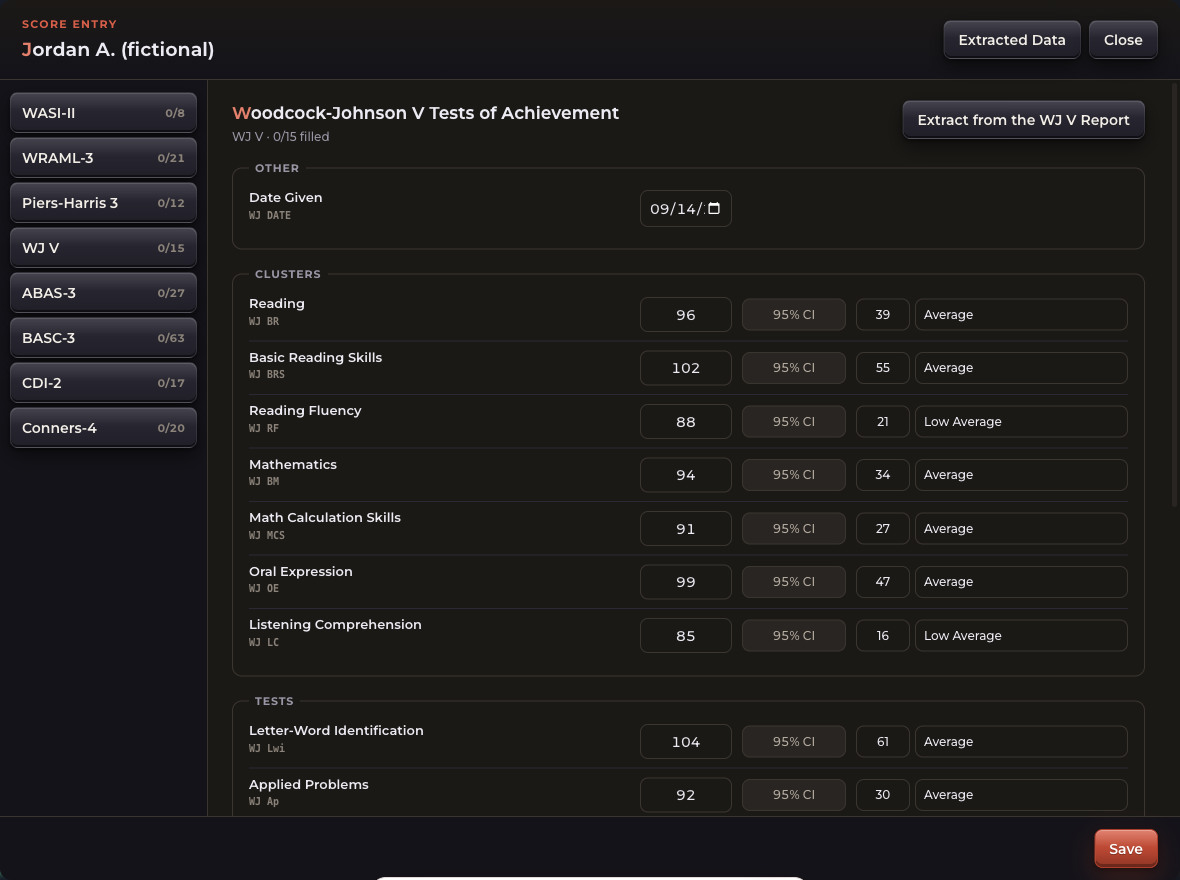 WJ V
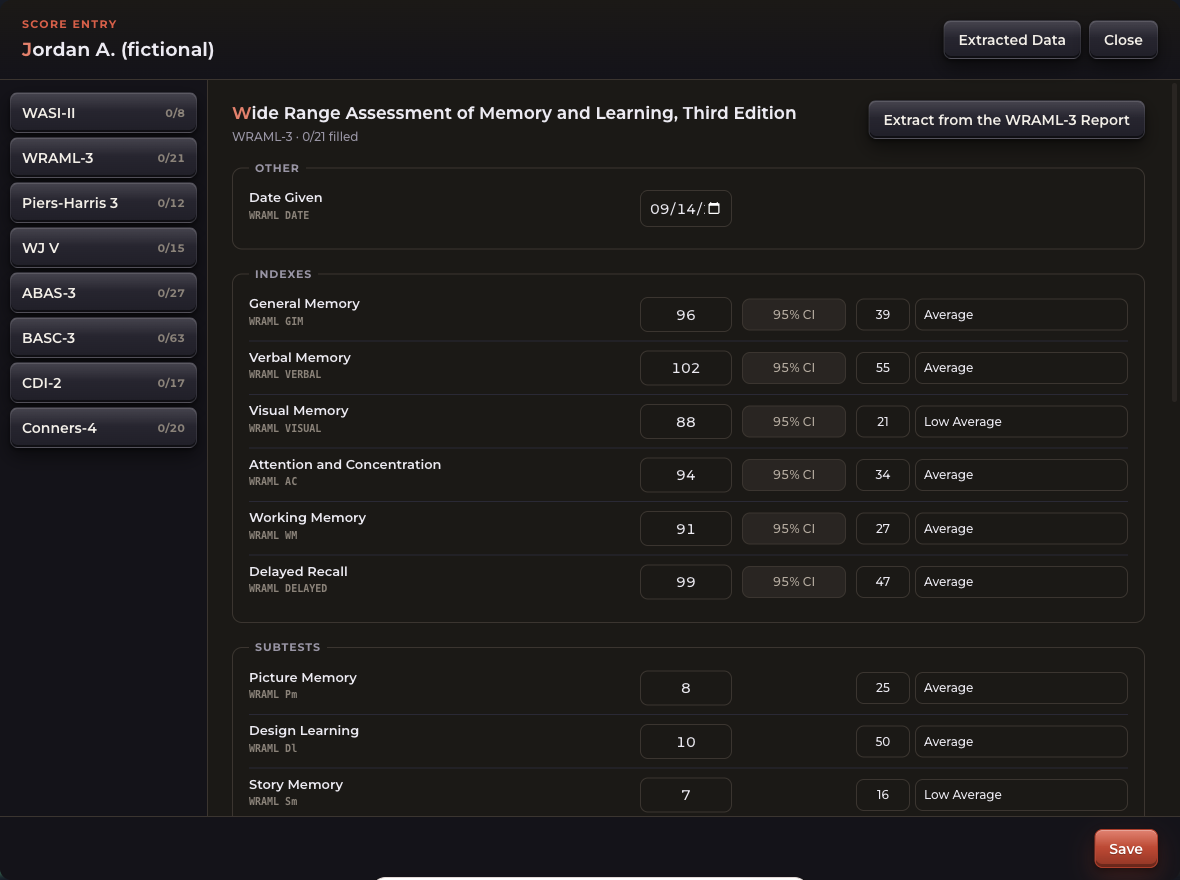 WRAML-3
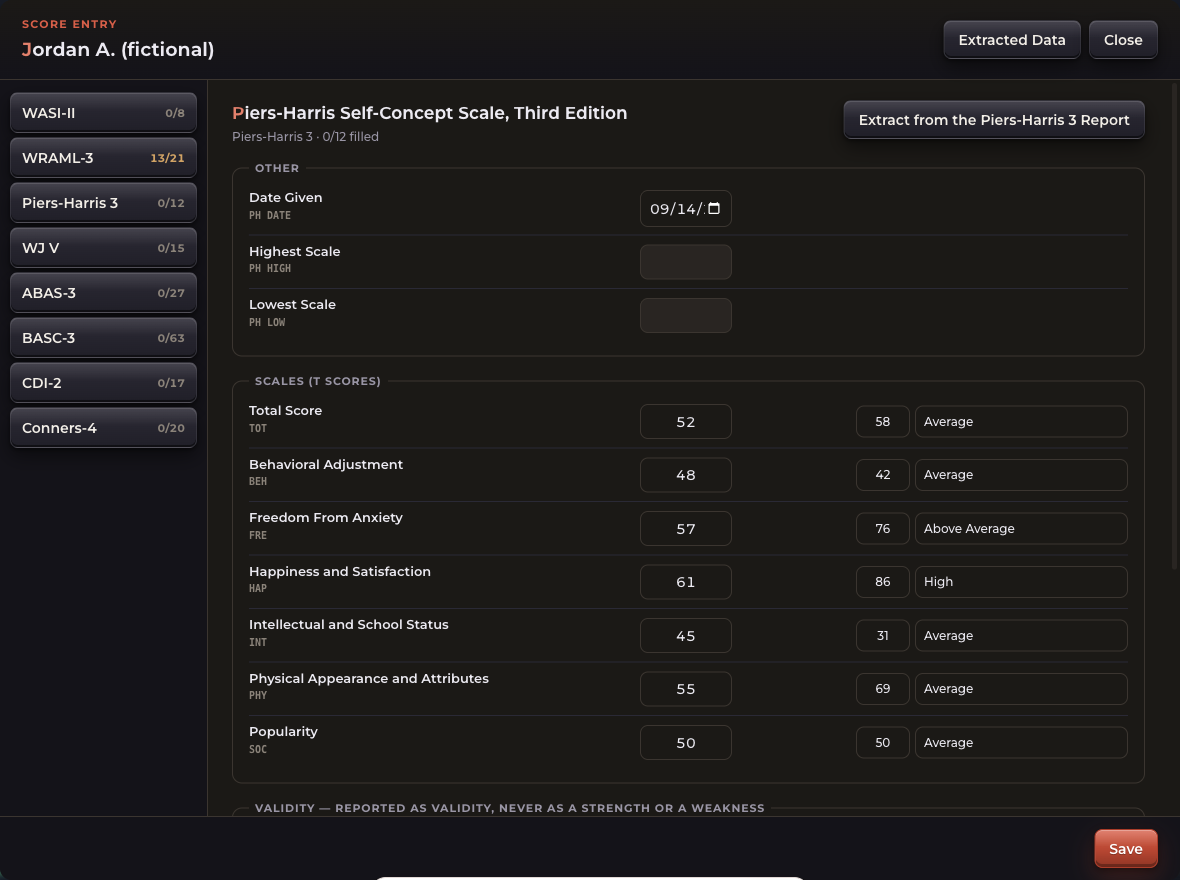 Piers-Harris 3
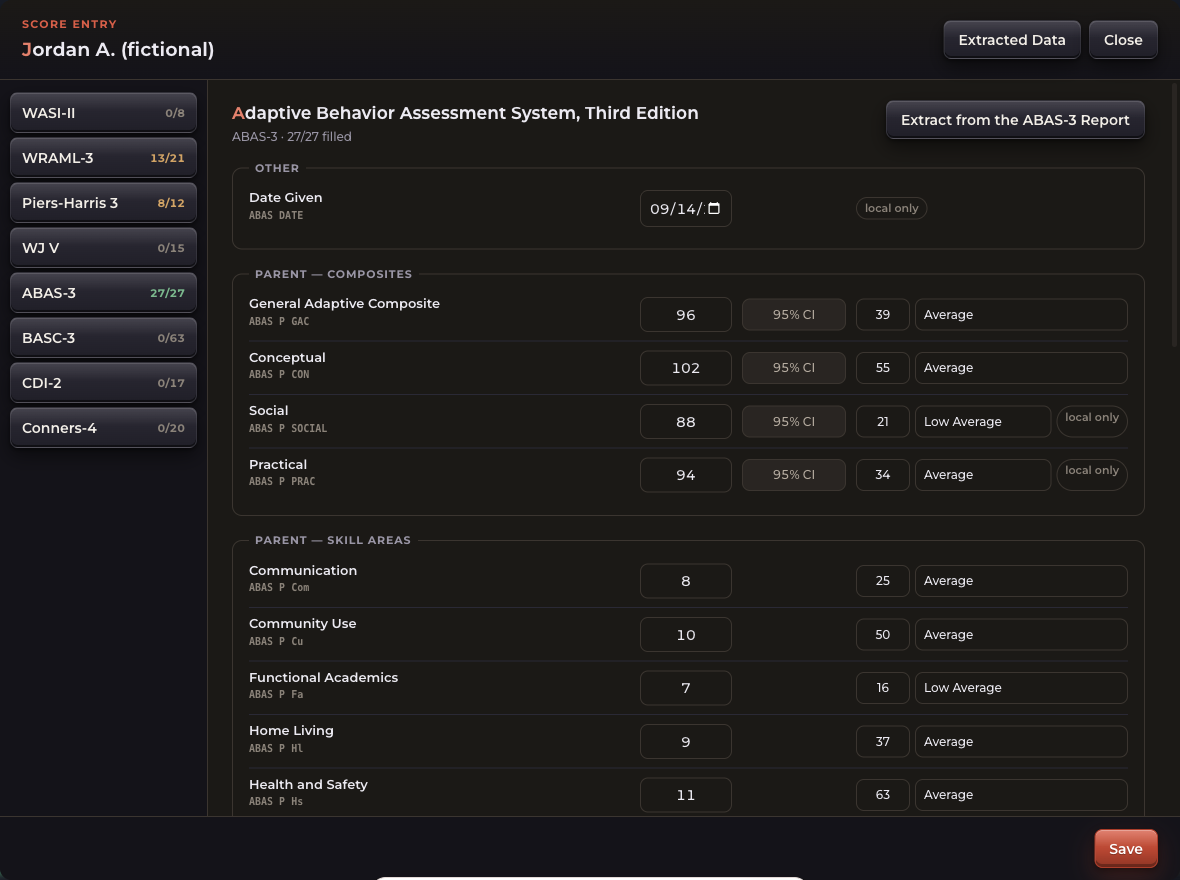 ABAS-3
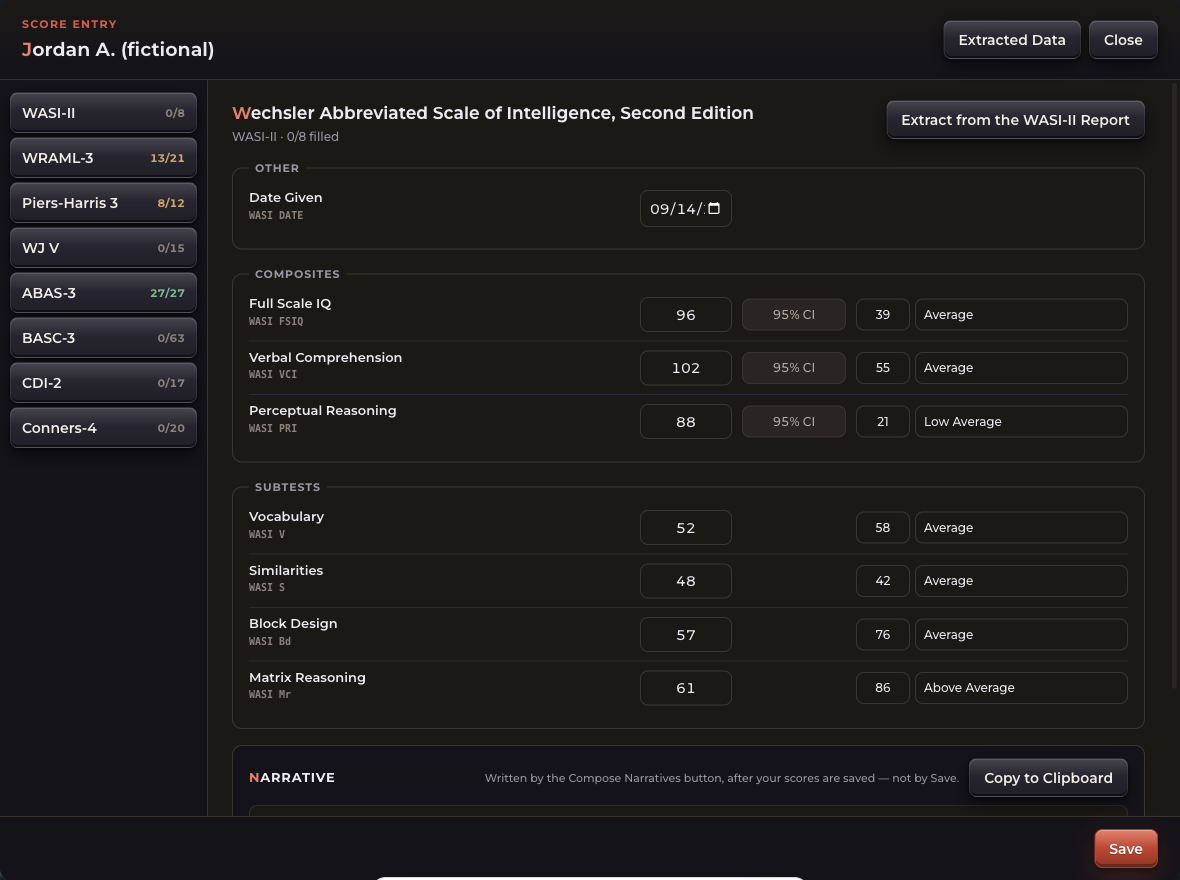 WASI-II
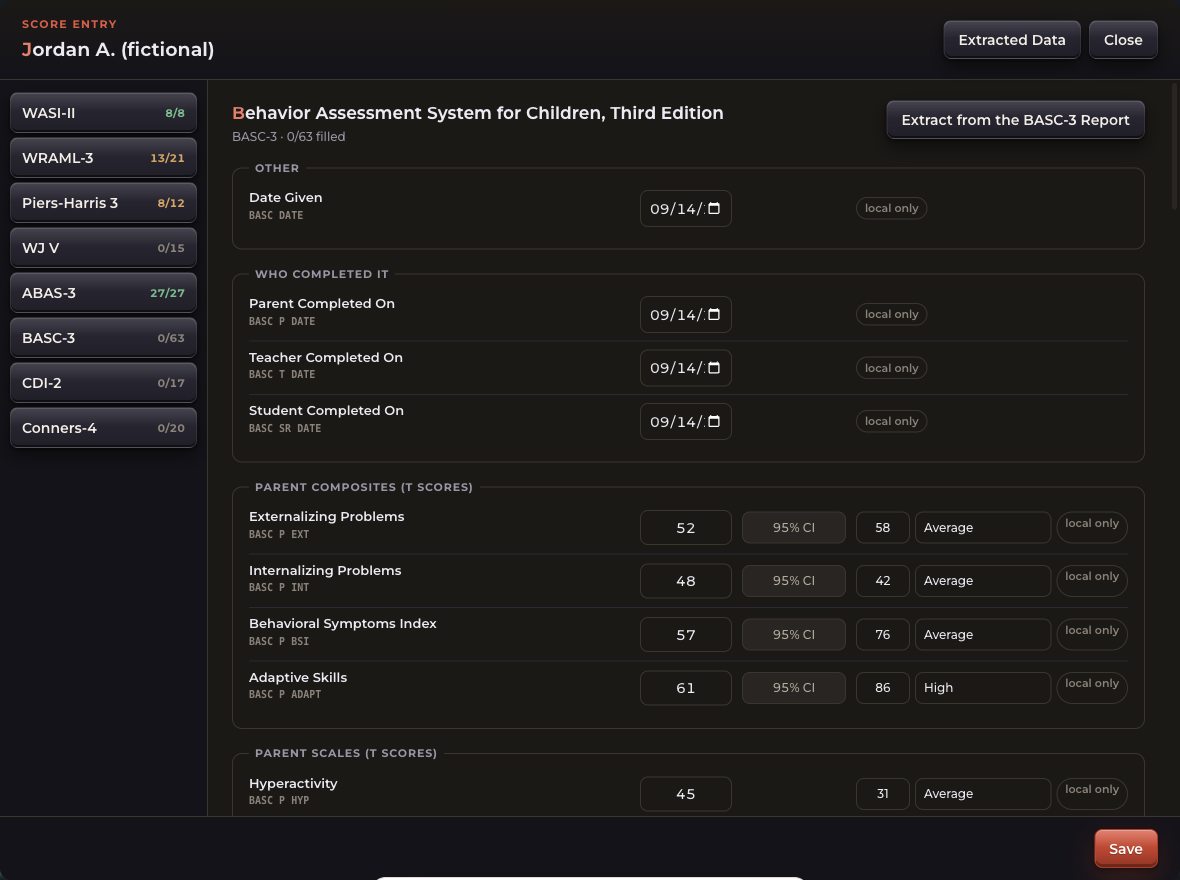 BASC-3
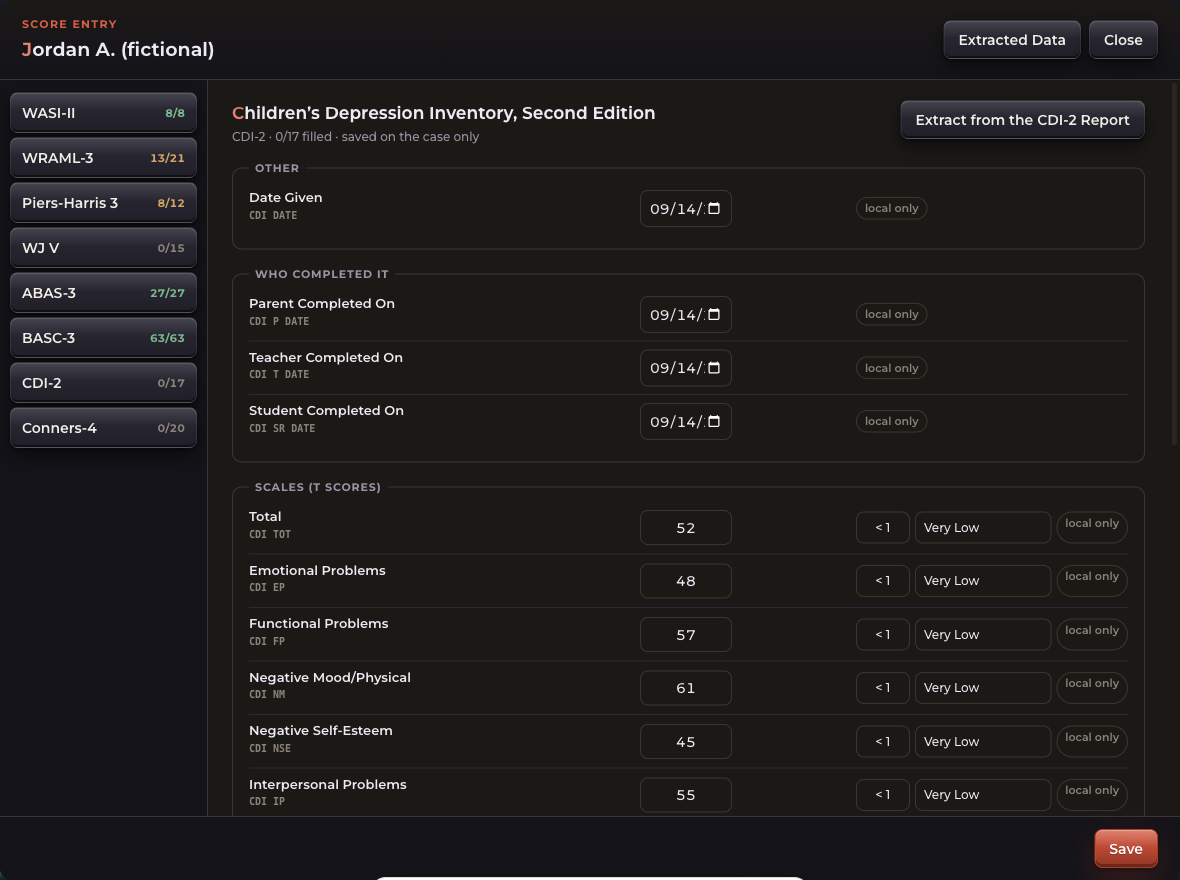 CDI 2
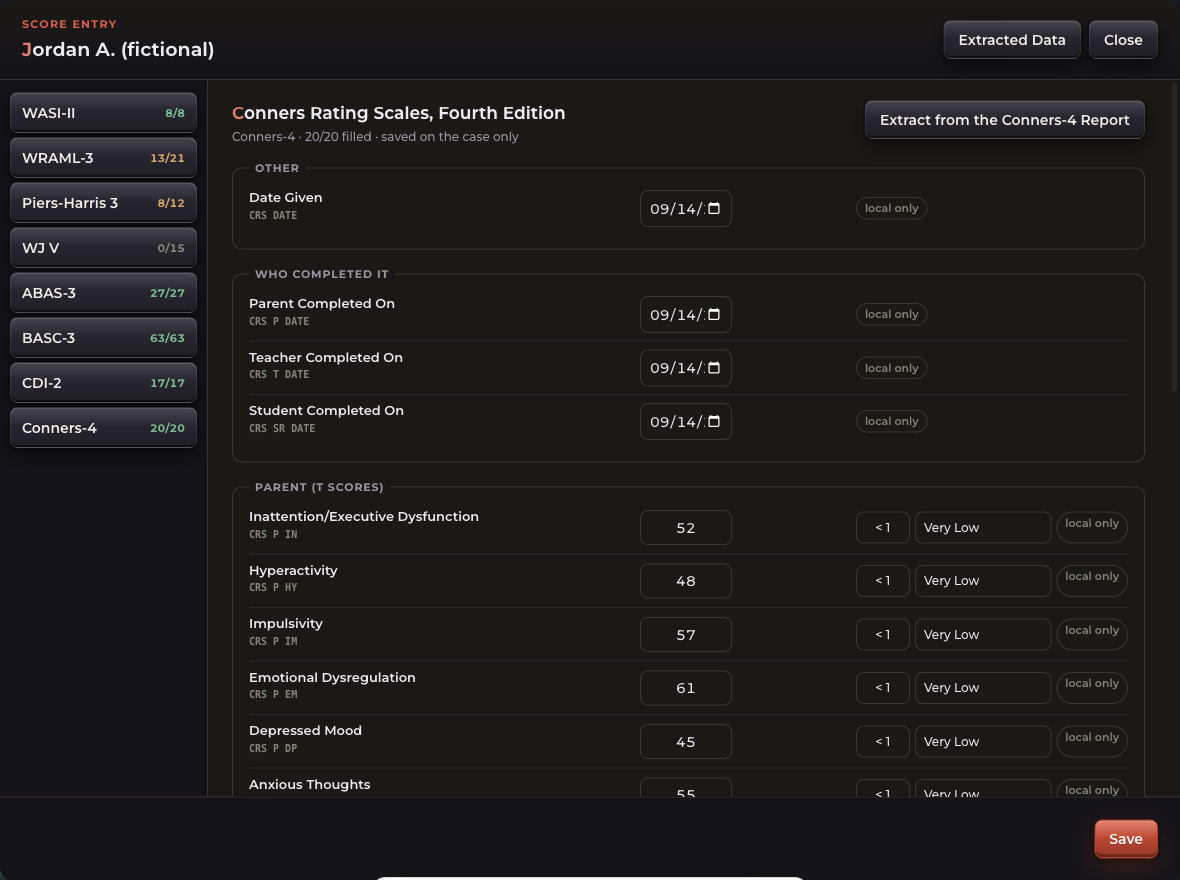 Conners 4
Four kinds of scores.
Most tests report one or more of these. Each compares the student with others the same age.
Average is 100. About two out of three students score between 85 and 115.
Used for smaller subtests. Average is 10; most students score between 7 and 13.
Common on rating scales. Average is 50; most students score between 40 and 60.
The percent of same-age students who scored the same or lower. The 50th percentile is right in the middle.
Each publisher uses its own words for score ranges (for example "Low Average" vs. "Below Average"), so descriptions can differ between tests. A report should always use the publisher's own labels. Want to see a score table turned into a graph and a paragraph? Try the live demo.
Cognitive / intellectual
Wechsler Intelligence Scale for Children, Fifth Edition
Ages 6 to 16
Overall thinking and reasoning ability. Gives a Full Scale IQ and five main areas: verbal comprehension, visual-spatial skills, fluid reasoning (solving new problems), working memory, and processing speed.
Scores: Standard scores (average 100); subtests as scaled scores (average 10).
Wechsler Abbreviated Scale of Intelligence, Second Edition
Ages 6 to 90
A shorter estimate of thinking ability using two or four subtests — useful for a quick check or a re-evaluation.
Scores: Standard scores (average 100); subtests as T-scores (average 50).
Woodcock-Johnson Tests of Cognitive Abilities
Ages 2 to 90+
A broad look at thinking abilities grouped into areas such as comprehension-knowledge, fluid reasoning, short-term working memory, processing speed, auditory and visual processing, and long-term retrieval.
Scores: Standard scores (average 100).
Test of Nonverbal Intelligence, Fourth Edition
Ages 6 to 89
Reasoning with pictures and patterns, with no speaking, reading or writing needed — helpful when language, hearing or motor needs could make other tests unfair.
Scores: Standard score (average 100).
Academic achievement
Woodcock-Johnson Tests of Achievement
Ages 2 to 90+
Reading, writing and math skills — from sounding out words and spelling to reading comprehension, math facts and problem solving.
Scores: Standard scores (average 100).
Wechsler Individual Achievement Test, Fourth Edition
Ages 4 to 50
Reading, written expression, math, and oral language skills compared with same-age or same-grade students.
Scores: Standard scores (average 100).
Kaufman Test of Educational Achievement, Third Edition
Ages 4 to 25
Reading, math, written language and oral language, with error analysis that shows which skills are breaking down.
Scores: Standard scores (average 100).
Memory and processing
Wide Range Assessment of Memory and Learning, Third Edition
Ages 5 to 90
How well a student learns and remembers what they see and hear, and how well they hold attention on a task — right away and after a delay.
Scores: Index standard scores (average 100); subtests as scaled scores (average 10).
Comprehensive Test of Phonological Processing, Second Edition
Ages 4 to 24
The sound skills behind reading: hearing and working with the sounds in words, remembering sounds, and naming quickly.
Scores: Composite scores (average 100); subtests as scaled scores (average 10).
Test of Auditory Processing Skills, Fourth Edition
Ages 5 to 21
How a student takes in and makes sense of what they hear — sounds, spoken words, and following spoken directions.
Scores: Standard scores (average 100); subtests as scaled scores (average 10).
Test of Visual Perceptual Skills, Fourth Edition
Ages 5 to 21
How a student makes sense of what they see — matching, remembering and finding shapes — without needing to draw.
Scores: Standard scores (average 100).
Beery-Buktenica Developmental Test of Visual-Motor Integration
Ages 2 to 99
How well the eyes and hands work together, by copying shapes of increasing difficulty.
Scores: Standard scores (average 100).
A Developmental Neuropsychological Assessment, Second Edition
Ages 3 to 16
Specific brain-based skills such as attention and planning, language, memory, visual-spatial skills, and social perception.
Scores: Subtests as scaled scores (average 10).
Social-emotional and behavior
Behavior Assessment System for Children, Third Edition
Ages 2 to 21 (self-report 8 and up)
Rating scales completed by parents, teachers and the student about behavior, emotions and everyday coping — for example attention, anxiety, depression, conduct, and social skills.
Scores: T-scores (average 50); higher is more concern on problem scales, lower is more concern on adaptive scales.
Piers-Harris Self-Concept Scale, Third Edition
Ages 6 to 22
How a student sees themselves — at school, with friends, their appearance, their behavior, and their happiness.
Scores: T-scores (average 50).
Conners, Fourth Edition
Ages 6 to 18
Rating scales about attention, hyperactivity, impulsivity and related concerns, from parents, teachers and the student.
Scores: T-scores (average 50).
Adaptive behavior
Vineland Adaptive Behavior Scales, Third Edition
Ages Birth to 90
Everyday living skills — communicating, taking care of oneself at home and in the community, and getting along with others.
Scores: Standard scores (average 100).
Adaptive Behavior Assessment System, Third Edition
Ages Birth to 89
Everyday skills in three areas — conceptual, social and practical — rated by parents and teachers.
Scores: Composite standard scores (average 100); skill areas as scaled scores (average 10).
Templates, guides and a live demo.
These descriptions are general summaries for families and practitioners, not a substitute for the publisher's manual. Test names are trademarks of their publishers.